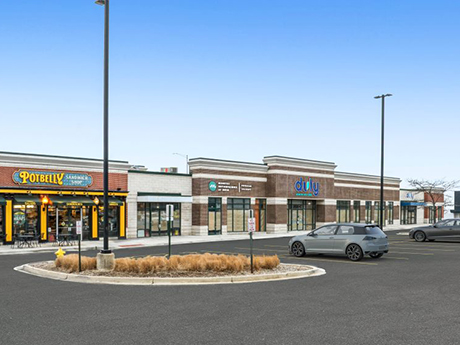
A 21,071-square-foot Lombard center sold for $10.1 million after a 2026 renovation, fully leased to Duly Health, Midwest Orthopaedics at Rush and Potbelly.
A fully leased sale anchored by medical tenants
Full occupancy and a recent medical-focused renovation give the $10.1 million sale of a Lombard retail center its clearest market signal: buyers were acquiring an income-producing property with established tenants. The 21,071-square-foot center at 2830 S. Highland Avenue sold to a local private capital group, with JLL Capital Markets handling the transaction. That combination of a reported sale price, identified buyer type and named tenants offers a useful outline of the deal, though it leaves many of the details needed to judge the income stream undisclosed.
JLL’s Alex Sharrin, Mohsin Mirza, Will Bowater, Michael Nieder and Brian Page represented the seller, a joint venture of HSG Medical and Capital Healthcare Properties. The property was fully leased at closing to Duly Health and Care, Midwest Orthopaedics at Rush and Potbelly Sandwich Works. Medical services form the center’s main tenancy, while Potbelly adds a food retailer to the mix. That’s a recognizable pattern in retail property: service businesses can occupy storefront space while drawing customers for purposes beyond conventional shopping.
What the tenant mix says—and what it doesn’t
Medical tenants can bring a different rhythm of visits from shops that depend mainly on discretionary purchases. Patients may have scheduled appointments, while people seeking other health services can make repeat visits over time. Those patterns can support regular activity at a center, but they don’t establish how many customers visit this property, how long tenants will remain, or whether the leases produce comparable income.
Potbelly’s presence also matters to the way the center serves its surrounding area. Food retailers often rely on access, visibility and nearby activity, while medical providers tend to serve people seeking specific care. Together, the uses suggest a center organized around practical needs, but the article doesn’t report the site’s layout, parking, traffic counts or the tenants’ operating hours. Without those details, the tenant names describe the use mix more clearly than they describe the property’s day-to-day performance.
Here’s the thing: a fully leased building can look straightforward at closing, yet occupancy is only one measure of its financial condition. Lease length, renewal options, rent levels, expense responsibilities and tenant credit all shape how dependable the income may be. The reported details don’t include those terms or pricing by tenant, so the sale announcement can’t show how much of the purchase price reflects current rent, future rent expectations or the value of the recent work. That gap is common in brief transaction reports, and it limits what readers can responsibly infer.
The renovation and the condition of the asset
Built in 2003, the center was fully renovated in 2026 for its new medical tenancy. The timing matters: the sale followed the work, and the building was 100 percent occupied. A renovation tied to a medical use can involve adapting space to meet the needs of providers and patients, although the article doesn’t specify what construction or equipment was included here. It also doesn’t say who paid for the work or whether the renovation was completed before the tenants began operating.
For a buyer, recent improvements may reduce the immediate need for some types of capital spending, but that depends on what was renovated and the condition of components that weren’t mentioned. Medical users can have particular requirements for interior configuration and building systems, and those requirements vary by provider. The phrase “fully renovated” therefore signals meaningful work without serving as a full building-condition report. This is more significant than it looks: the investment may have helped prepare the center for its current tenants, but the available description doesn’t establish how long the improvements will remain adequate for them.
The center’s age provides context, not a verdict. Buildings completed in the same year can have very different maintenance histories, layouts and levels of upkeep. In this case, the source connects the 2026 renovation to the medical tenancy, but says nothing about other upgrades or deferred maintenance. If you’re working in this space, that distinction matters when comparing assets: a renovation date helps orient the discussion, while a detailed scope is needed to understand what was actually delivered.
Reading the price with care
At $10.1 million for 21,071 square feet, the reported price gives readers a basic scale for the transaction. It doesn’t, by itself, reveal whether the buyer paid a premium or discount relative to the property’s income, condition or local alternatives. That would require information such as net operating income, lease structure and comparable sales, none of which is provided in the article.
Nor does the identity of the buyer as a local private capital group establish its strategy or expected holding period. Private capital groups can have varied objectives, and the available facts don’t disclose this buyer’s plans. The same caution applies to the seller: the joint venture’s name identifies who sold the asset, but no reason for the sale is stated. The transaction is therefore best read as evidence that a buyer acquired a fully occupied, recently renovated center—not as proof of a wider shift in local property values.
Why the deal may matter to the market
Medical-oriented retail centers sit between traditional shopping properties and healthcare facilities. They use retail space and often serve a local customer base, but their day-to-day demand is tied to care providers and patient visits. That category can interest buyers looking for occupied space with service-oriented tenants; still, the label alone says little about a particular asset’s risk. Tenant concentration, lease expirations and the costs of adapting space for a replacement user can all affect the outlook, and those factors aren’t detailed here.
And yet, the sale offers a concrete signal about this center’s position at closing: it had three named tenants, was reported fully leased and had undergone a renovation for its medical tenancy before changing hands. Those facts may have helped make the property legible to prospective buyers, since occupied space provides an immediate operating story. But without lease and income data, the strength of that story remains difficult to measure. A clean occupancy figure is useful. It isn’t the whole underwriting.
(And this is the part most people overlook.) A tenant mix can sound diversified because it includes several business names, while the actual income may still depend heavily on a small number of leases. The article doesn’t disclose how much space or rent each tenant represents, so the degree of concentration can’t be assessed. For anyone following the sale, that missing detail is central to understanding how much stability the occupancy figure really represents.
What to watch in the next account
Future information about the center would make the transaction easier to compare with other retail sales. Lease duration, rental income, tenant space allocations and the renovation’s scope would clarify the building’s operating profile. Details about the property’s configuration and surrounding retail context could also help explain how well the site serves its tenants, but none is included in the reported account.
For now, the deal’s clearest story is a straightforward one: a local private capital group bought a fully leased Lombard center with a medical-focused tenant mix after a renovation tied to that use. The price and square footage give the transaction a defined scale, while the absence of income and lease details limits deeper conclusions. A useful signal, then—but a partial one.
Discussion
Sign in to join the discussion.