A newly built 7-Eleven truck stop in Johnstown sold for $15.6 million with 15 years remaining on its triple-net lease.
7-Eleven sale puts a long lease behind a $15.6 million price
The investment story here is the lease. A private investor has acquired a newly built 7-Eleven (Speedway) truck stop and convenience store in Johnstown, Ohio, for $15.6 million, with 15 years remaining on a triple-net lease. That term gives the buyer a long period of contracted occupancy, though the available details don’t disclose rent, rent increases, renewal options or other figures needed to assess the deal’s yield.
A triple-net lease generally assigns the tenant responsibility for property taxes, insurance and maintenance, subject to the specific language in the lease. That arrangement can make operating costs more predictable for an owner, but the label alone doesn’t tell the full story. The allocation of repairs, capital work and other expenses depends on the contract, and those obligations can matter over a long holding period. The lease is therefore the central asset here, but its headline term doesn’t reveal how much income the property produces or how that income might change.
The 4,816-square-foot property stands at the entrance to New Albany International Business Park, a 9,000-acre development near New Albany and suburban Columbus. It pairs a compact retail building with a truck stop use, placing the property at a gateway to a large employment and industrial setting. That location could support demand from workers, commercial traffic and other visitors, but the report doesn’t describe customer volumes, nearby competition or the extent to which business park activity contributes to sales.
What the location can—and can’t—tell us
Convenience stores and fuel-oriented sites are often valued for access, visibility and the regularity of customer trips. A position at the entrance to a major business park may put a property in front of people arriving for work or deliveries, while a truck stop can serve a different pattern of demand from a neighborhood convenience store. Those are useful features to consider, but they’re not proof of a particular level of business. The source doesn’t provide traffic counts, fuel sales, store revenue or operating data, so the location’s contribution to the $15.6 million price remains unclear.
The building’s modest size also needs to be read in context. The property’s value may depend less on its square footage than on the lease income, the tenant’s commitment and the site’s role in the surrounding area. In a single-tenant investment, there’s no other tenant income to offset a vacancy if the occupant leaves or stops paying. A long remaining lease can reduce near-term exposure to turnover, but it doesn’t eliminate questions about the tenant’s performance, the building’s condition or what happens when the lease term ends.
The missing figures behind the purchase price
The sale price and lease term make the transaction notable, but the numbers alone don’t tell us how the buyer underwrote it. Without the rent, it isn’t possible to calculate the property’s initial yield from the reported price. The lease’s escalation schedule matters too: fixed increases, periodic resets and flat rent can produce different income paths, even when the remaining term is the same.
Other details would help explain the risk the buyer accepted. The report doesn’t identify the lease’s renewal options, the precise division of repair responsibilities or whether the property includes equipment and site features with separate upkeep demands. Nor does it say whether the buyer plans to hold the asset through the full lease term. These omissions don’t make the transaction suspect; they limit what an outside reader can responsibly conclude from a sale price and a lease length.
There’s also a difference between a tenant commitment and a guarantee of uninterrupted performance. A lease documents obligations, while the investment’s practical value still depends on the tenant meeting them and the site remaining useful for the intended operation. For a fuel and convenience property, the physical layout, access and ongoing maintenance can shape how readily the site serves its customers. That’s the part most people overlook: a long contract can steady the income story, but it can’t make every operating or property risk disappear.
Buyer and seller
CBRE’s Melissa Marshall, Ian Schroeder and David McNevin represented the buyer, a private investor based in Southern California. The seller was an Ohio-based commercial real estate developer. The available account doesn’t identify either party beyond those descriptions or explain the seller’s reasons for the sale.
For a developer, selling a newly built property can turn a completed project into a sale proceeds event; for a buyer, acquiring it can provide an operating asset with a tenant already in place. Those are common functions of a sale-lease investment, but the source doesn’t say whether that framework drove this particular transaction. Here's the thing: the deal’s structure is visible at a high level, while the financial terms that would show how the parties priced its risks are not.
What the transaction signals
This is more significant than it looks as a reminder of how single-tenant properties are marketed: the remaining lease term and the tenant’s identity can lead the story, while the rent and expense details determine whether the price can be judged. If you're working in this space, you’ll want to distinguish a long lease from a fully understood income stream. The first is disclosed here; the second isn’t.
That said, the location gives the property a clear point of distinction. It sits at the entrance to a large business park and combines convenience retail with truck stop use, rather than relying on a conventional storefront setting alone. Whether that position supports durable demand can’t be established from the reported facts. The sale offers a useful snapshot of investor interest in a newly built, leased retail asset, but the available information stops short of showing the return profile or the assumptions behind the purchase.
A long lease. A prominent setting. And unanswered questions about income.
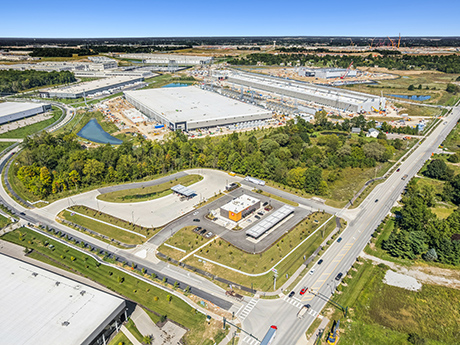
The 4,816-square-foot property, occupied by 7-Eleven, sits at the entrance to New Albany International Business Park.
Discussion
Sign in to join the discussion.