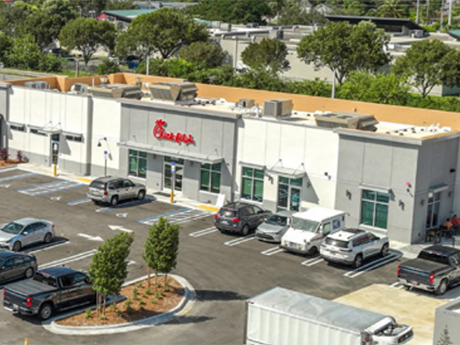
The 5,399-square-foot Miami Chick-fil-A sold for $8.9 million with 13 years remaining on its absolute triple-net lease.
Miami sale prices a long lease commitment
The notable feature of this $8.9 million Miami transaction is the length and structure of the income stream: Chick-fil-A has 13 years left on its initial lease term, and the lease is absolute triple-net with a corporate guarantee. That gives the buyer a defined, long-term commitment, though the available details don’t explain the buyer’s investment criteria or the transaction’s pricing metrics. The sale is therefore easier to describe in terms of its lease structure than to evaluate as a complete investment case. The price alone doesn’t reveal the rent, the return the buyer expects, or how the parties assessed the property.
An absolute triple-net lease generally places property-level costs and responsibilities on the tenant, subject to the terms of the agreement. That can make the landlord’s role more limited than under leases where the owner pays some expenses, but “triple-net” isn’t a substitute for reading the actual contract. The word “absolute” signals a particularly broad allocation of obligations, yet the source doesn’t specify which costs or responsibilities are addressed here. The corporate guarantee adds another layer of commitment: it ties the lease obligation to the company identified as guarantor, rather than leaving the buyer to rely only on the property itself. Its precise scope and conditions aren’t provided.
Here’s the thing: a long remaining term can make future income easier to model, but it doesn’t make that income risk-free. The buyer still depends on the tenant meeting its obligations and on the lease remaining in force under its terms. The 13 years apply to the initial lease term; the source doesn’t identify renewal options, rent increases, or what happens when that term ends. Those missing details matter when assessing how durable the income may be beyond the stated commitment.
What the lease structure tells buyers
In a sale of a leased restaurant property, the building’s operating business and the real estate income stream are related, but they aren’t the same thing. The buyer acquires the property subject to the lease arrangement described in the source. The restaurant tenant’s presence can provide a clear operating use for the building, while the lease sets the basis for the owner’s income and responsibilities. That division is central to understanding why a buyer might focus on lease duration and guarantees when considering a property of this kind.
Similar leased-property transactions are often assessed through several connected questions: how much income the lease produces, how that income changes over time, what expenses remain with the owner, and how long the tenant is committed. Here, only some of those points are disclosed. We know the remaining initial term and the broad lease structure, but not the rent schedule, escalation provisions, operating costs, or the pricing metric used to arrive at the $8.9 million sale price. Without those figures, readers can’t calculate a capitalization rate or compare the deal’s yield with another property’s.
This is more significant than it looks: the stated lease terms describe a framework for income, not the income’s value. Two properties with similar lease durations can carry different pricing depending on their rents, expenses, contractual provisions, and other characteristics. None of those comparisons can be made from the reported details alone. The transaction’s price is a concrete figure, but it isn’t enough to establish whether the buyer paid a premium, secured a discount, or met its own target return.
If you’re working in this space, the distinction between a strong-looking lease summary and a fully assessable transaction is familiar. A corporate guarantee and a long remaining term are meaningful attributes, but their weight depends on the lease language and the economics attached to it. And this is the part most people overlook: the phrase “13 years left” says how much time remains on the initial term, not what the property will earn each year or what options may follow. The numbers here are underwhelming in one respect: the sale price is known, while the metrics needed to judge it aren’t.
The property and the parties
SRS Real Estate Partners negotiated the ground lease sale for the restaurant property at 18240 S. Dixie Highway. The 5,399-square-foot building was completed in 2024. Patrick Nutt and William Wamble of SRS represented the seller, a joint venture of Berkowitz Development Group and Landsea Development Group. The buyer is based in New York.
The property’s recent completion gives the transaction a specific physical context: it’s a newly completed restaurant building, rather than an older property whose sale would need to account for a long operating history or deferred work. That observation shouldn’t be stretched into a claim about its condition, construction quality, or future maintenance needs; the source doesn’t provide those details. Nor does the building’s size, by itself, establish how efficiently the site operates or how its price compares with other restaurant properties.
The ground lease description also calls for care. The source identifies the sale as a ground lease sale and describes the restaurant lease as absolute triple-net, but it doesn’t explain the full ownership structure or set out the ground lease’s terms. Those labels describe important parts of the transaction, yet they don’t supply every detail needed to understand how the land, building, and tenant obligations relate. For readers, the reported facts establish the location, size, completion year, parties, and headline lease features. The contract and financial terms would be needed to go further.
What the transaction leaves unanswered
The buyer’s New York base is disclosed, but the source doesn’t identify the buyer or explain its strategy. It would be speculation to assign a portfolio goal, preferred return, or reason for choosing this property. The same restraint applies to the seller: the named joint venture developed the property, but the report doesn’t state why it sold or what it plans to do with the proceeds.
That said, the deal illustrates why leased restaurant properties can attract attention from buyers who value a defined tenant commitment. A long lease and a corporate guarantee can make the expected income easier to frame than income from a property that must find a tenant, though the actual financial picture still depends on undisclosed terms. The structure may also mean the owner has fewer routine property expenses to manage, but the exact allocation can’t be confirmed from the summary. A useful signal, then. Not a full valuation case.
For the market, the transaction offers a reported sale price and a compact set of property facts, but no basis for drawing a broader conclusion about Miami pricing or demand. One sale doesn’t establish a trend, and this report provides no comparable transactions. What this means for you is that the deal can be read confidently as a sale anchored by a long remaining lease commitment, while its yield and relative value remain open questions. The next useful details would be the rent schedule, lease provisions, and pricing metrics; without them, the $8.9 million figure has context, but limited analytical reach.
Discussion
Sign in to join the discussion.