Lexington’s Fritz Farm is adding 30,387 square feet of retail and dining space across three buildings, with tenant shell spaces expected in December.
New capital backs Fritz Farm’s next phase
The $104 million recapitalization of Fritz Farm combines a refinancing with a new source of capital: Kimco Realty is coming in as a preferred equity investor. Those are distinct parts of the transaction, and the equity investment may matter as much as the headline financing. It gives Kimco a position in the property while senior financing comes from funds managed by Blackstone. Newmark arranged the deal, with Chris Kramer and Dan Axelson securing the senior financing and Conor Lalor representing Hendricks Commercial Properties (HCP), which bought Fritz Farm in 2025.
A recapitalization can change how a property is financed without changing what visitors see day to day. Here, the announcement also ties the financing to a physical expansion, making the deal relevant to both the ownership structure and the center’s retail plans. The release doesn’t explain the terms of Kimco’s preferred equity, the refinancing’s maturity, or how the new capital is allocated beyond the stated project investment. Those omissions make it difficult to assess the full financial picture from the headline figure alone.
HCP, based in Beloit, Wisconsin, is putting $14.1 million into an expansion of the center’s retail and dining space. Three new buildings will add 30,387 square feet to the existing 330,077 square feet of retail. Construction started in March, and tenants are expected to receive shell spaces in December. That handoff marks a construction milestone, not a confirmed opening date: the announcement doesn’t say when shops or restaurants will begin operating.
A mixed-use center with room to grow
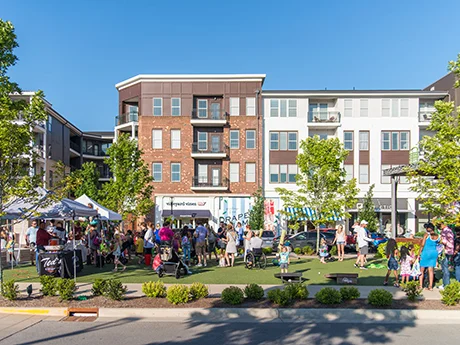
Fritz Farm covers 52 acres in Lexington, Kentucky. Bayer Properties first developed the property as The Summit at Fritz Farm, and the center opened in 2017. Bayer is now part of Centennial Real Estate. The site combines more than 60 shops and restaurants with luxury apartments and a hotel, so the retail addition sits within a larger mixed-use development rather than a standalone shopping project.
That setting changes how the expansion should be read. Retail and dining can serve residents, hotel guests and visitors drawn to the center’s existing shops, while the apartments and hotel give the property activity beyond a single shopping trip. The announcement doesn’t say how much of that activity comes from each group, or whether the new space is aimed at a particular customer. Without tenant names or a stated leasing strategy, the project’s intended draw remains an open question.
Here’s the thing: adding more than 30,000 square feet to an already substantial retail base is a measured extension, not a wholesale change in scale. The center’s current retailers include Anthropologie, Apple, Arhaus, Bath & Body Works, Brandy Melville, Free People, Kendra Scott, Lush, Nike and Pandora. That roster shows the range of brands already present, but it doesn’t tell readers which tenants will occupy the new buildings or whether the mix will shift. The numbers here are underwhelming as a measure of transformation, though the addition could still matter if the space attracts tenants that add a distinct reason to visit.
What the expansion will need to prove
For a mixed-use center, more retail space can broaden the range of shops and dining options, but square footage alone doesn’t establish that the addition will strengthen the property. Leasing and the eventual tenant mix will do more to define the project’s effect. And this is the part most people overlook: receiving shell space is only one step in the process. Tenants still need to prepare their spaces before opening, and the announcement gives no opening timetable.
If you're working in this space, the practical detail to watch is whether the new buildings fill a gap in the existing offer or mostly extend what’s already there. The center has an established retail base and other uses on site, which gives the expansion a wider context. But the source provides no tenant commitments, leasing figures or expected visitor impact, so claims about stronger foot traffic or sales would be premature. The useful question is narrower: what businesses will take the space, and when will they open?
That said, the transaction pairs a substantial refinancing with a defined construction program and a stated project budget. Those are concrete steps, even if they don’t resolve the question of demand. Fritz Farm’s next phase is underway. Whether it becomes a meaningful draw will depend on what arrives in the three buildings and how those tenants fit the center’s existing mix.
Discussion
Sign in to join the discussion.