Tennessee leads the nation in farmland value growth, with prices soaring nearly 6% in the past year amid rising development and population influx.

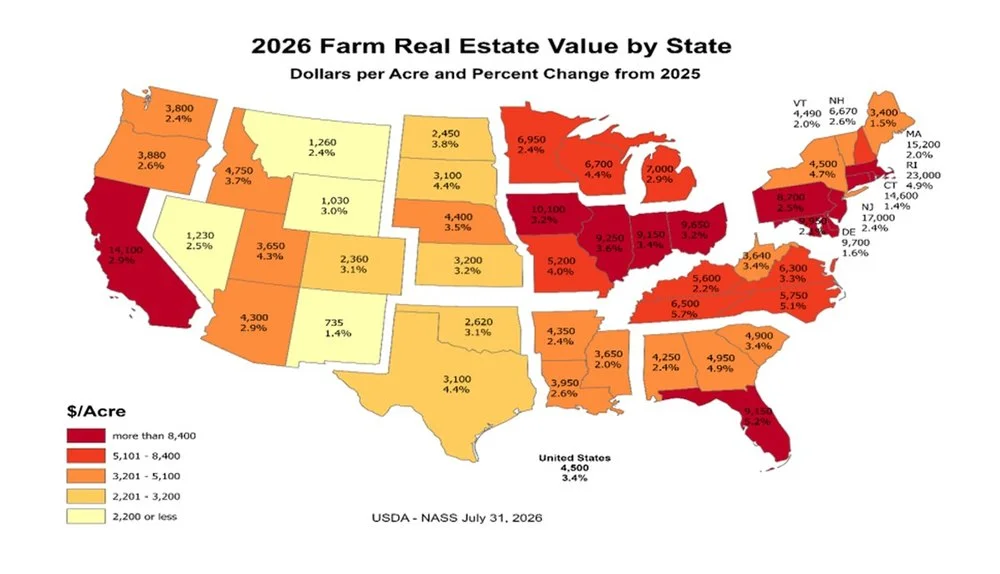
Farmland values in Tennessee are experiencing remarkable growth, outpacing the national average with a rise of 5.7% over the past year. According to the latest report from the U.S. Department of Agriculture, the price per acre in the state climbed from $6,150 in 2025 to $6,500 in 2026, signaling a significant trend in agricultural real estate.
This steep increase follows a prior year’s growth where farmland value surged by 7.7%, underscoring the consistent demand for agricultural land in Tennessee. Comparatively, the national median farmland price reached $6,020 per acre in 2026, reflecting a more modest 3.4% increase from the previous year.
Factors Driving Tennessee's Land Value Growth
The acceleration in farmland prices in Tennessee can be attributed to various interlinked factors, most notably an unprecedented wave of development across the state over the past two decades. For instance, land in rapidly expanding areas like Murfreesboro has skyrocketed from initial prices of about $4,000 to $6,000 per acre to current valuations between $25,000 and $40,000. This surge isn't just numbers; it signifies a transformation in land use and investment potential in the region.
Moreover, according to data from the University of Tennessee at Knoxville's Boyd Center for Business and Economic Research, Tennessee's population is on the rise, experiencing its highest growth since 2008. An influx of approximately 80,000 new residents between 2023 and 2024 plays a critical role in elevating demand for housing and agricultural land alike. As more people settle in the area, they consume resources, require infrastructure, and, inevitably, justify the rising land prices.
The Nashville metro area, specifically, ranks third nationally for the proportion of new construction. This trend is buoyed by the state's favorable tax environment, which includes the absence of an income tax and relatively low property taxes. Although the sales tax stands at 7%, it hasn't deterred businesses from relocating. Major corporations like Oracle, Amazon, and Dell have established their headquarters in Tennessee, further intensifying competition for available land. This influx of businesses not only creates jobs but also increases the demand for housing, which in turn, drives farmland prices up as urban sprawl pushes outward.
The interplay between population growth and economic expansion is a driving force behind the rising values. As people move to Tennessee for job opportunities, housing demand naturally rises, placing additional strain on land prices. What’s intriguing here is how agricultural land is also benefitting from these commercial and residential dynamics—there's a mounting recognition that such lands can become prime real estate as urban areas expand. If you're working in this space, you'll see how vital these trends are for forecasting land value trajectories.
Comparative Analysis: Tennessee's Position in the National Market
While states like Rhode Island and Iowa command higher average farmland prices, Tennessee's position as a front-runner in year-over-year value increases is noteworthy. The state's advantageous development climate, characterized by significant urban growth and a favorable regulatory environment, sets it apart. With an aggressive rate of growth, one might think such an environment could lead to unsustainable bubbles, but the underlying economic factors indicate robust support for continued expansion.
One potential risk lies in the agricultural sector’s vulnerability to market fluctuations and weather conditions. While the current growth is fueled by demand and investment, external factors such as climate change and commodity prices can disrupt this trend. Farmers in Tennessee, alongside developers, must remain vigilant. They have to strike a balance between capitalizing on rising land values and maintaining sustainable agricultural practices—another critical aspect that often gets overlooked.
Implications and Future Outlook
The implications of rising farmland values in Tennessee extend beyond mere numbers. They signal shifts in land use, economic opportunity, and demographic changes. Agricultural land that was once primarily used for farming is increasingly seen as a potential canvas for urban development and conservation projects. This duality presents both opportunity and concern, particularly regarding sustainable land management practices and zoning regulations.
The trajectory of farmland values is likely to influence not just local economies but also national agricultural markets. As developers and investors flock to areas with increasing land values, they may create a ripple effect impacting other regions. And yet, while some areas flourish, others that don’t have the same economic catalysts could lag behind. This divergence underscores the need for policymakers and community leaders to focus on balanced growth that champions environmental stewardship alongside economic development.
Discussion
Sign in to join the discussion.